
Why Composite Absorbent Cores Are Becoming Important in Modern Diapers
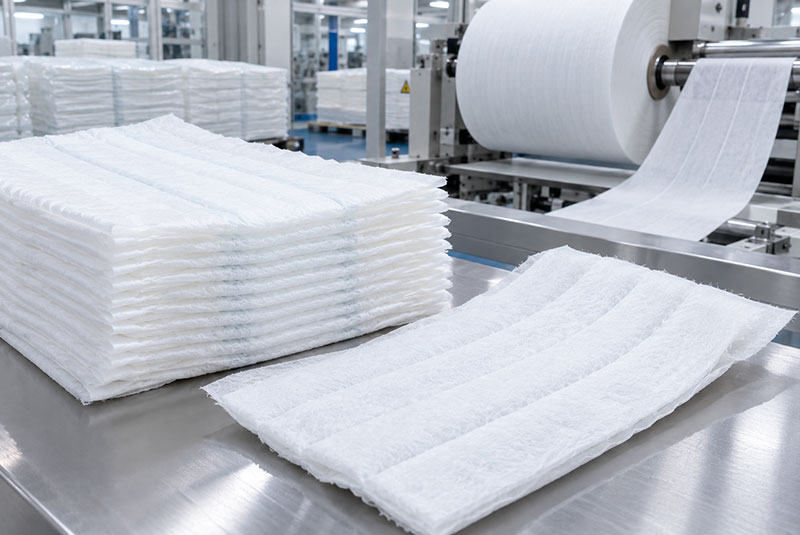
The disposable hygiene industry continues to move toward thinner, lighter, and more comfortable products. As a result, composite absorbent core structures are receiving increasing attention from diaper manufacturers looking for new ways to balance absorbency, structural stability, and product thickness.
What Is a Composite Absorbent Core?
Unlike a conventional structure that primarily relies on a loose mixture of fluff pulp and superabsorbent polymer (SAP), composite core designs can integrate SAP with multiple functional layers, such as nonwoven materials and tissue, to create a more controlled absorbent structure.
The purpose is not simply to add more absorbent material. Instead, the structure is engineered to manage how liquid enters, spreads, and is retained throughout the core.
Depending on the product design, composite cores can be produced separately and supplied as a pre-made material for integration into diaper production lines.
Thinness and Absorption Performance
One of the major advantages manufacturers seek from composite core technology is the ability to create a thinner finished diaper.
A bulky diaper does not necessarily mean better absorption. By optimizing the distribution and utilization of SAP, manufacturers can develop compact structures capable of providing effective liquid storage while reducing unnecessary thickness.
A thinner core can also contribute to improved flexibility and fit, which are increasingly important characteristics in modern baby diapers and other disposable hygiene products.
Better Structural Stability
Core stability is another important consideration. During use, the absorbent material is exposed to body movement, compression, and repeated liquid loading.
A well-designed composite structure helps maintain the distribution of absorbent materials throughout the core. This can reduce unwanted shifting and help the diaper maintain a more consistent shape during use.
Uniform SAP distribution is particularly important because excessive concentration in certain areas may result in uneven swelling and inefficient use of the available absorbent capacity.
Opportunities for Diaper Manufacturers
Composite absorbent cores provide manufacturers with additional flexibility when developing products for different market segments. Core specifications can be adjusted according to requirements for thickness, absorbency, dimensions, basis weight, structure, and finished-product positioning.
This makes composite core technology suitable for manufacturers developing different product ranges, from economical everyday diapers to thinner premium products.
As global hygiene markets continue to demand better comfort and performance, absorbent core design is evolving from a simple material combination into a carefully engineered system. For diaper manufacturers and hygiene product brands, choosing a suitable core structure can become an important part of product development and differentiation.
Contacts Us