
What Diaper Manufacturers Should Consider When Selecting an Absorbent Core
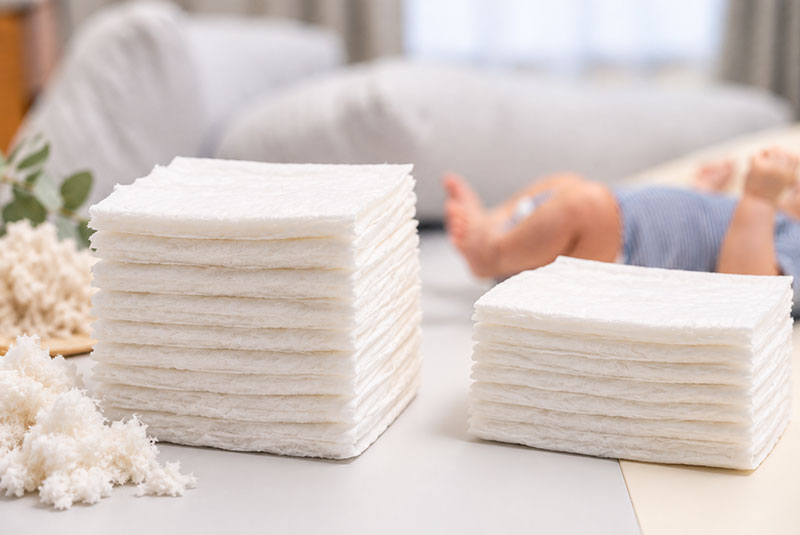
Selecting the right absorbent core is an important step in diaper product development. Different markets may require different levels of absorption, thickness, comfort, and cost efficiency, which means there is no single core specification suitable for every diaper.
For manufacturers, private-label brands, and hygiene product distributors, several key factors should be evaluated when sourcing absorbent core materials.
1. Absorption Capacity
Total absorption capacity is naturally one of the first considerations. The required capacity depends on the diaper size, target user group, intended wearing time, and overall product positioning.
However, manufacturers should avoid evaluating a core based only on its maximum absorption figure. Effective performance also depends on how quickly and evenly the liquid reaches the absorbent material.
2. Liquid Acquisition and Distribution
Fast liquid acquisition helps move moisture away from the surface, while efficient distribution allows more of the absorbent area to participate in liquid storage.
If liquid remains concentrated in one area, part of the core may become saturated while other areas remain underutilized. A properly designed absorbent system therefore needs to balance acquisition, distribution, and retention.
3. SAP Distribution
Superabsorbent polymer plays a major role in liquid storage. Its quantity, quality, and distribution inside the core can significantly influence finished-product performance.
Uniform SAP distribution helps support consistent absorption throughout the core. Manufacturers should therefore consider not only SAP content but also how effectively it is integrated and stabilized within the absorbent structure.
4. Core Thickness
Thinness has become an important requirement in many diaper markets. A thinner absorbent core can help manufacturers create products that are lighter, more flexible, and easier to package.
The challenge is achieving this reduction in thickness without compromising liquid management and structural integrity. Core design should therefore be evaluated as a complete system rather than simply by reducing individual materials.
5. Structural Integrity
The core must remain functional during manufacturing, transportation, storage, and actual use. Poor structural stability can lead to absorbent material displacement, deformation, or uneven performance.
Composite structures and suitable core wrapping materials can help stabilize absorbent materials and maintain more consistent core geometry.
6. Production Compatibility
For B2B buyers, production compatibility is just as important as laboratory performance. Width, thickness, roll specifications, basis weight, cutting requirements, and converting-line compatibility should be confirmed before mass production.
Consistent material specifications can help manufacturers maintain stable production efficiency and reduce unnecessary adjustments during converting.
Choosing a Core for the Target Market
The ideal absorbent core should ultimately match the positioning of the finished diaper. Premium ultra-thin diapers, standard baby diapers, training pants, and other hygiene products may require different core structures and performance specifications.
Working with a supplier capable of adjusting core dimensions, structure, absorbency, and related technical parameters can give manufacturers greater flexibility when developing products for different customers and markets.
As diaper designs continue to evolve, the absorbent core is becoming more than an internal component. It is a key technical platform that directly influences the performance, comfort, thickness, and competitiveness of the finished hygiene product.
Contacts Us