
How Absorbent Core Technology Improves Diaper Performance
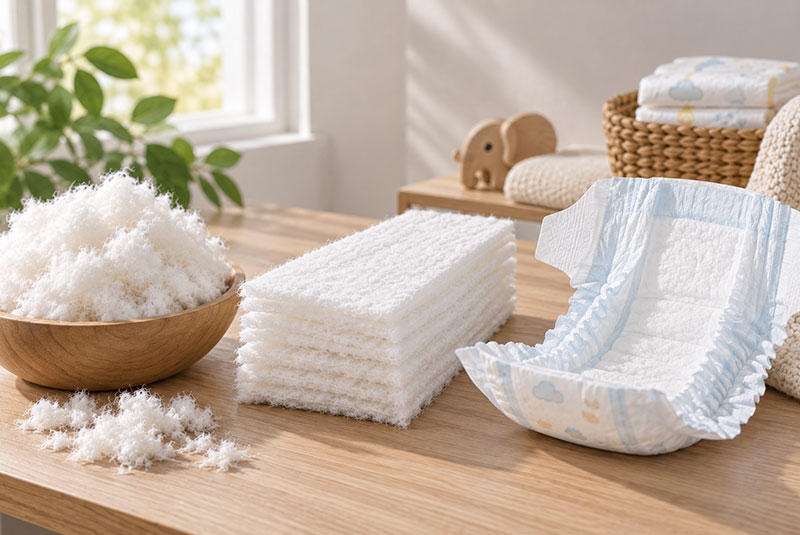
The absorbent core is one of the most important functional components of a disposable diaper. Although consumers often pay attention to softness, fit, and appearance, the performance of a diaper largely depends on how efficiently its core can acquire, distribute, absorb, and retain liquid.
The Role of the Absorbent Core
A typical diaper absorbent system is designed to manage liquid through several stages. After liquid passes through the topsheet, it needs to be quickly transferred away from the surface and distributed across the absorbent area. The core then absorbs and stores the liquid, helping reduce surface wetness and the risk of leakage.
Traditional absorbent cores commonly use a combination of fluff pulp and superabsorbent polymer (SAP). Fluff pulp provides rapid liquid acquisition and distribution through its fiber structure, while SAP offers strong liquid retention capacity. The balance between these materials directly affects absorption speed, total capacity, thickness, and core stability.
Moving Toward Thinner Core Structures
Modern diaper manufacturers increasingly require thinner and lighter absorbent structures without sacrificing performance. Higher SAP ratios can help increase liquid retention while reducing the amount of bulky fluff pulp required.
However, simply increasing SAP content does not automatically create a better core. Liquid distribution, SAP positioning, structural stability, and material compatibility must all be carefully considered. An optimized core structure allows liquid to spread efficiently across a larger absorbent area instead of concentrating in one location.
Why Core Stability Matters
Core integrity is particularly important during actual use. Movement, pressure, and repeated liquid loading can affect the internal structure of the diaper. An unstable core may experience material shifting, cracking, or uneven swelling, potentially reducing effective absorption.
For this reason, modern composite absorbent cores increasingly focus on maintaining a stable structure before and after liquid absorption. Proper material distribution and structural design help keep SAP in position while supporting more uniform liquid absorption.
Supporting Modern Diaper Manufacturing
For diaper manufacturers, absorbent core materials must provide not only reliable absorption performance but also good processing consistency. Stable thickness, basis weight, dimensions, and material distribution contribute to smoother converting and more consistent finished products.
As the hygiene industry continues to develop thinner, more comfortable, and higher-performance products, absorbent core technology will remain a key area of innovation. Selecting the appropriate core structure can help manufacturers balance absorption, dryness, comfort, production efficiency, and cost for different market requirements.
Contacts Us